About Us | Visual Tools | Thinking Maps® | Resources | Research | Home

Mapping the Standards
Mapping the Standards
is a process and a product
Teachers who are being trained in Thinking Maps and Software create lesson plans using TMS (Thinking Maps Software).
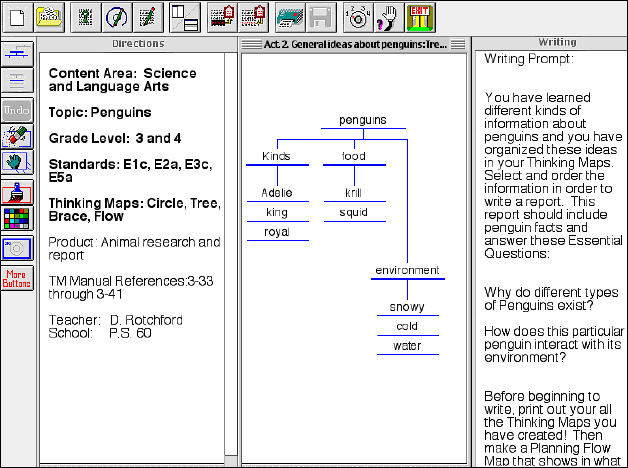
These lessons are entered into a special data-base so that all teachers in the school and district may access them at any time. The design work and Thinking Maps created by teachers and the products by students may be easily added to and modified, much as paragraphs in a word processing document may be manipulated, moved, or deleted. Across a district, teachers will be able to share these documents with others who are teaching similar content and processes by simply opening up the data-base. Thus a teacher (or student for that matter) reading and learning about penguins in one school may have access to Maps and Writing done by others using the same topic.
Here is a sample from the Mapping The Standards project using Thinking Maps software:
Heidi Hayes Jacobs has teachers graph what they teach throughout a year and then show this in a continuum chart. This is a useful big picture view of what is being taught. So how is it being taught consistently? And are higher-order thinking skills being facilitating systematically across grade levels and content areas? Thinking Maps training and TMS support the creation, transfer, and modification of high quality, standards-based lessons across a system.
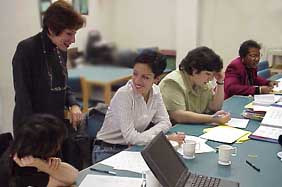 |
Here is Lynn Kanter, a Trainer of Trainers in District 27 in New York City, working with colleagues who are linking Thinking Maps to content learning through the New York City and State Standards. |
Expected Outcomes of Mapping the Standards
The outcomes are many and at several levels. Here are the most obvious outcomes:
- Teachers and students gain a high level of fluency with TMS.
- The implementation / change process of Thinking Maps will be supported.
- Instructional use of Thinking Maps are directly linked to the Standards.
- Collaboration and sharing of ideas within and across schools will be facilitated.
- Fluency and versatility with thinking skills and Thinking Maps will be elevated.
- Technology will be integrated into the core learning tools of the classroom.
- Teachers will have access to more documents showing how to use Thinking
Maps and thus will be able to provide more support to students. - Student documents will reveal how thinking skills based units of study-- activated by Thinking Maps--supports meeting the standards.
- Assessment and self-assessment by teachers and students will be supported by the new capacity to scan a wide range of documents.
Contact us about bringing Mapping The Standards to your district!