

About Us | Visual Tools | Thinking Maps® | Resources | Research | Home

Research
• Thinking Foundation
 The mission of the non-profit Thinking Foundation is to support high quality research on cognitive skills development, creativity, and critical reflection—at pre-school, K-12 and college levels in order to transform learning, literacy, teaching and leadership around the world for those with the greatest need.
The Thinking Foundation website includes case studies, graduate studies, video, and documentary films on the use of visual tools. The research includes in depth understanding of Thinking Schools and the use of Thinking Maps® in whole school, district and international settings.
Thinking Foundation invites those in the field of pre-kindergarten to college level education, including teachers, administrators, and researcher s, to submit research proposals under a Request for Proposals.
• Case Studies
Special Needs: Learning Prep
West Newton,  Since September 2002, student performance at this school has improved as demonstrated by an increase in vocabulary acquisition, concept attainment, an ability to make connections, and an ability to establish relationships. The students' overall learning process has been facilitated by the use of these visual tools. Using Thinking Maps, students have been able to develop cognition and comprehension strategies in order that they may bridge the gap between current and projected abilities. As evidenced by the 2002 MACS Retest scores, Thinking Maps have proven to be an integral tool for students to retain and retrieve content, attain concepts, and forge connections. Teachers' fluency with Thinking Maps is tracked as well, to ensure that students are receiving the maximum benefit possible.
 Go to the Learning Prep School Case Study
ELL: Roosevelt Elementary School: A First Language for Thinking in a Multilingual School
Long Beach, CA
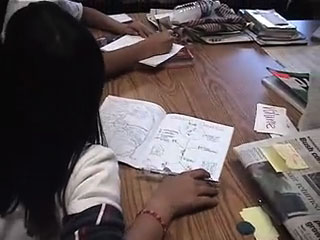 My intent as the instructional leader of Roosevelt School [Stefanie R. Holzman, Ed.D.] was initially isolated on these tools for a direct and immediate impact on student performance. What I didn't realize and could not foresee were the deeper effects upon the development of teachers across our year-round, multitrack school as a result of the use of Thinking Maps in their classrooms. Read about Roosevelt Elementary School including video clips and test data.
Go to the Roosevelt Elementary School Case Study
Video
The video clips on the Thinking Foundation website include selections from pre K through 12 and college. The video clips include seeing students, educators and administrators from across the USA and around the world including Mexico, Japan, and Britain. The clips include the following categories: Leadership, Literacy, Whole School Change, Mathematics, Special Education, ELL, Reading Comprehension, Writing, Coaching/Mentorship.
Go to the Thinking Foundation video clips
• Documentary Films
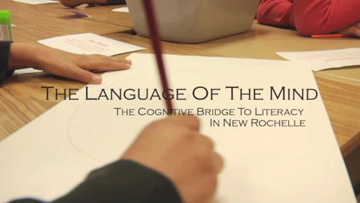 Thinking Maps and English Language
Learner (ELL) Effectiveness
New Rochelle School District, New York, USA
How do we support a very high level of cognitive development and deep academic content learning for students learning a second language? Watch "The Language of the Mind” documentary trailer above and learn more about Thinking Maps and ELL Effectiveness.
read more...
 Whole School & District Change
Pass Christian School District, Mississippi, USA
The Pass Christian School District Story is one of gain in the midst of loss. Watch the trailer below and read the story of overcoming a seemingly insurmountable task...
read more...
Dissertations and Graduate Studies
The Research Section on the Thinking Foundation website is divided two categories: Research Areas and Research Types including the research areas:
- Literacy - Reading Comprehension
- Literacy - Writing
- Mathematics
- Special Education
- English as a Second Language (ESL)
- Whole School Professional Development
- Coaching / Mentoring
- Leadership
Read the research on the Thinking Foundation site
• Books and Research on Visual Tools
Visual Tools for Transforming Information Into Knowledge
David Hyerle, Author
Arthur L. Costa, Prologue
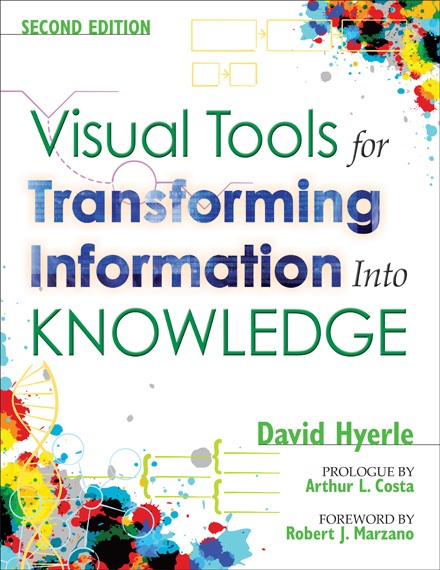 Robert J. Marzano, Foreward
Corwin Press, 2009, Second Edition, 167 pages
This is the most comprehensive book on graphic organizers, Thinking Maps®, and graphic software programs. Find out why visual tools and mapping are the key tools for 21st century learning. Look at student and teacher work and review test results from around the country. In a rich and provocative writing style, David Hyerle, Ed.D. draws together examples from teachers, administrators, brain researchers, and parents to make a very exciting read.
Read excerpts from the following chapters and contents:
- Contents
- Chapter 1: The Mapping Metaphor
- Chapter 2: Facilitating the Networking Brain and the Patterning Mind
Developing Connective Leadership
Successes With Thinking Maps®
Larry Alper, David Hyerle, Kimberly Williams, Authors
Solution Tree Press, 2012
"If our best thinking comes by making connections and building patterns, then what would these patterns look like, and what might they be based on?"—ask the authors. Most importantly, how could they be used?
Developing Connective Leadership shows you how Thinking Maps® are an efficient and eloquent language that can be used to explore and reveal ideas, thought processes, and intentions. By creating visual representations of thought, leaders create shared understandings and foster connections among staff.
Explore how schools have used the Thinking Maps® process to create strong collaborative bonds and facilitate shared leadership. As staff members collaborate to construct a shared frame of reference, they are empowered to execute and sustain the school's vision.
Benefits:
- Offers real-life experiences from school leaders using Thinking Maps® for professional development
- Identifies eight Thinking Maps® used to build connective leadership practices
- Suggests how Thinking Maps® can be used to reformulate and reconstruct negative or damaging frames of reference
- Discusses how Thinking Maps® can energize and inspire insight and solutions
Student Successes With Thinking Maps 
David Hyerle, Editor, with Sarah Curtis and Larry Alper coeditors,
Corwin Press, Second Edition, January 2011
Neuroscientists tell us that the brain organizes information in networks and maps. What better way to teach students to think about ideas and organize and express their ideas than to use the very same method that the brain uses. This book provides an invaluable way to help our students truly understand and retain the concepts behind the facts, and to do this in an exciting and motivating way.
Read excerpts from the book (Acrobat PDF files):
- Elementary School - A First Language for Thinking in a Multilingual School by Stephanie Holzman, Ed.D.
- Middle School - Feeder Patterns and Feeding the Flame at Blalack Middle School by Edward V. Chevallier, M.Ed.
- High School - Embracing Change: The Evolution of Thinking in a K-12 School by Gill Hubble, M.A.
- University - The Mississippi Story by Marjann Kalehoff Ball, Ed.D.
- International - The Singapore Eperience: Student Centered Fluency by Ho Po Chun, M.Ed.
For more information including excerpts and accompanying video clips go to the following links:
- About the Book Student Successes
- About the Contributors
- The Chapters — extensions and more
- Order the Book
Thinking Maps: The Cognitive Bridge to Literacy
A Visual Language for Bridging Reading Text Structures to Writing Prompts
By David Hyerle, Ed.D. and Thommasina DePinto Piercy, Ph.D.
A comprehensive book focused on the wide ranging applications of Thinking Maps, from preschool through college. The working title of this book of collected chapters from 15 authors is: Thinking Maps: A New Language for Learning.
Read one chapter - Acrobat PDF file
More Influential Books in the Field of Visual Tools
Learning How To Learn (1984)
Joseph Novak and Bob Gowin
Cambridge University Press.
Patterns of Thinking (1991)
John Clarke
Needham Heights, MA
Allyn and Bacon
Maps, Mindscapes, and more (1993)
Nancy Margulies
Tucson, AZ: Zephyr Press
I See What You Mean (1995)
Steve Moline
York, ME: Stenhouse Press.
The Mind Map Book (1996)
Tony Buzan
New York: Plume/Penguin
A Field Guide to Using Visual Tools (2000)
David Hyerle
Alexandria, VA: ASCD
• Research on Thinking and Thinking Maps®
